

|Published on: 1st April 2026|Categories: News|
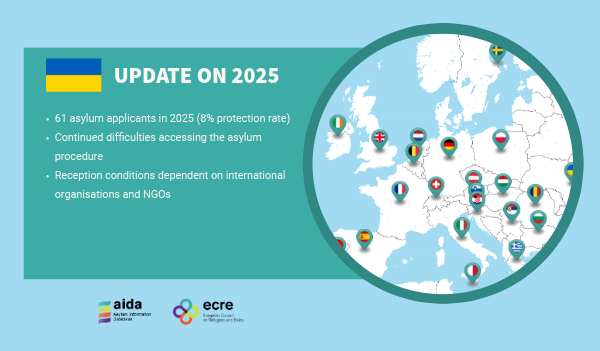
The updated AIDA Country Report on Ukraine provides a detailed overview on legislative and practice-related developments in asylum procedures, reception conditions, detention of asylum applicants and content of international protection in 2025.
A number of key developments are set out below.
- Ongoing war: Due to Russia’s full-scale invasion of Ukraine in February 2022 and the ongoing war, the number of new asylum applicants and developments regarding the country’s asylum system are limited compared to earlier years.
Asylum procedure
- Statistics: 61 people applied for asylum in Ukraine in 2025 (including 31 from Russia, nine from Tajikistan and seven from Belarus) and there were 729 new and ongoing cases throughout the year. In the preliminary stage of the asylum procedure, the authorities made 47 decisions (concerning 54 applicants) to send cases for further examination and they issued 11 negative decisions. In the further examination procedure, of a total of 128 decisions, one resulted in the granting of refugee status, nine in the granting of national complementary protection and 118 in rejection (8% protection rate).
- Access to the territory and the asylum procedure: In accordance with legislation that was adopted in 2023, it remained impossible to lodge an asylum application at the border in 2025. Since no data on refusals of entry and detentions on the ground of ‘illegally crossing the border, breaching the rules of staying in the territory of Ukraine and other violations’ is available for 2025, it is not possible to determine how many people may have been affected by it.
- Refusal to register applications: Territorial bodies of the State Migration Service of Ukraine (SMS) continued to verbally refuse to register asylum applications without issuing written decisions in 2025. In addition, there were reports of the SMS invoking Article 9 of the 1951 Refugee Convention when they refused to register asylum applications from Belarusian nationals, citing national security considerations linked to the war and referring to Belarus as a “satellite state of the Russian Federation”. This interpretation has, however, been rejected by Ukrainian courts.
Reception conditions
- Access to reception conditions: No significant legislative changes were introduced in 2025. Asylum applicants continued to access reception conditions only after their application entered the preliminary examination stage and they were not provided with a state financial allowance.
- Reception capacity and occupancy: Ukraine’s three reception centres had a total capacity of 421 places in 2025. However, at the end of the year, they only had one resident between them.
- Role of international organisations and NGOs: Reception conditions continued to depend largely on support from international organisations and NGOs in 2025. In addition to assistance provided by the United Nations Refugee Agency (UNHCR) and its partners, the NGO Right to Protection also provided support, including coverage of medical expenses and the provision of supermarket vouchers and emergency grants aimed at covering urgent household needs.
Detention of asylum applicants
- Detention statistics: 317 people were placed in migrant custody centres (MCC) in 2025 (compared to 253 in the 2024) and 421 stayed in them during the course of the year (377 in 2024). The majority of detainees were undocumented people, including people who had attempted to apply for asylum but who had not been issued documentation or who had lost their legal grounds to stay.
- Access to asylum and legal assistance in detention: Concerns persisted regarding detention practices affecting asylum applicants in 2025. In some cases, people who attempted to apply for international protection were issued return or deportation orders and subsequently detained in MCCs. Access to the asylum procedure from detention facilities remained difficult due to limited information on asylum procedures, restricted access to legal assistance and infrequent visits by migration authorities. There were also reports of attempts to remove certain detainees rapidly, including Russian nationals, despite ongoing protection concerns.
Content of international protection
- Return permits: Protection beneficiaries who fled Ukraine following the full-scale invasion of the country in 2022 were not been able to receive or extend their certificates and travel documents abroad. In some cases, they were also unable to obtain a certificate from a diplomatic mission abroad that would have allowed them to return to Ukraine in order to renew their documents. In 2024, some people who had been granted complementary protection were able to obtain return permits from Ukrainian embassies with the support of lawyers and, in 2025, some recognised refugees and people who had been granted complementary protection were able to obtain these permits without legal assistance.
- Naturalisation: Whereas nobody with refugee status obtained Ukrainian citizenship in either 2023 or 2024, 30 recognised refugees were granted Ukrainian citizenship in 2025.
The full report is available here.
For more information about the AIDA database or to read other AIDA reports, please visit the AIDA website.
